

The True Cost of Enterprise AI
Most AI Projects Quietly Bleed ROI

Rik Wright

Artificial intelligence (AI) initiatives are now deeply embedded in enterprise strategies across virtually every primary industry, accompanied by record levels of quarterly investment.
Yet a growing number of executives express a persistent concern: while implementations may achieve technical deployment, the expected returns on investment (ROI) remain elusive.
This shortfall is not necessarily due to project failure in the conventional sense. On the contrary, many AI systems function as designed. The difficulty lies in the systematic underestimation of the actual cost structure of AI adoption. Rather than collapsing outright, projects often underperform financially because unforeseen and ongoing expenditures erode projected budgets. The central challenge for leadership is learning to forecast and manage the entire financial trajectory of AI technology implementations.
Initial Projections Represent Only the Visible Costs
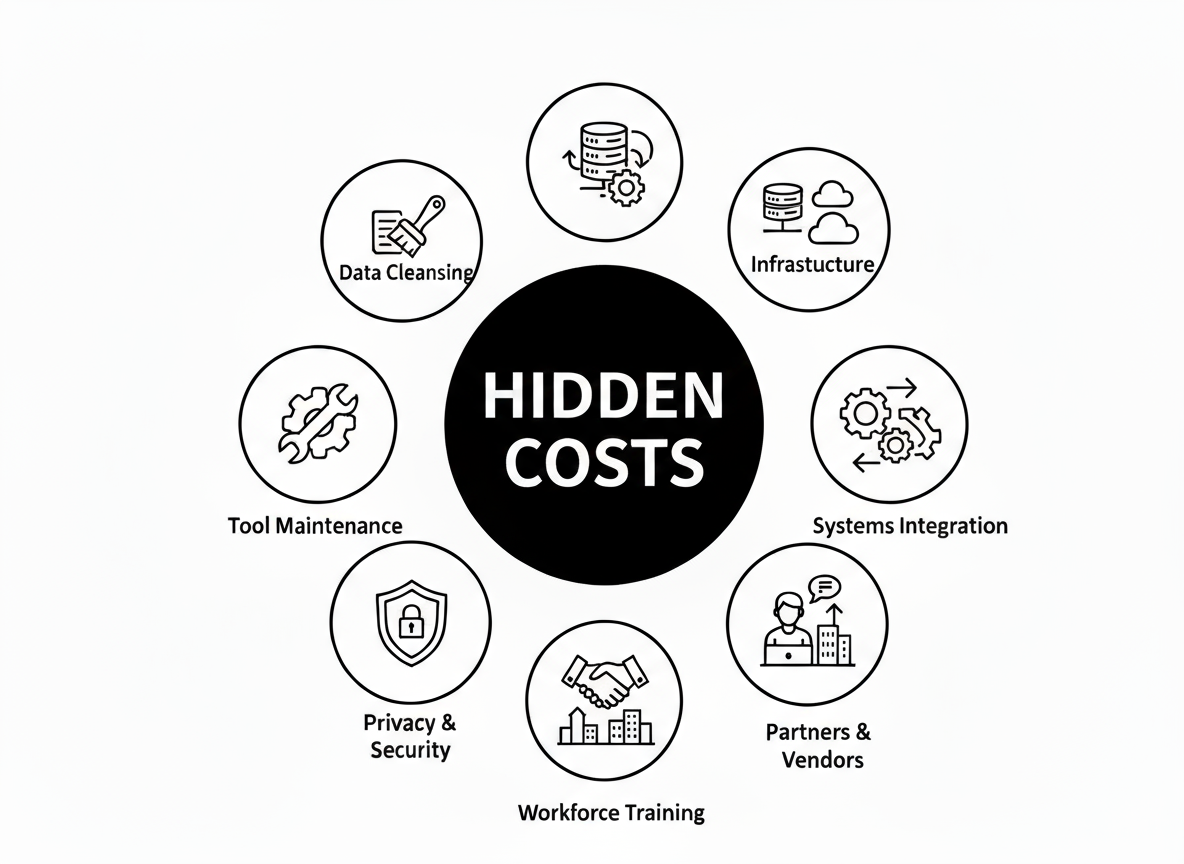
Enterprise AI proposals typically emphasize direct and easily quantified expenses, such as software licenses, consultancy fees, and cloud infrastructure commitments. However, these projections often overlook the broader lifecycle costs that extend beyond the initial launch. Building robust data pipelines, scaling system architecture, and enforcing governance structures are not one-time activities but ongoing obligations. Thus, the conventional budget often accounts only for the “visible tip” of the expenditure iceberg. At the same time, the more substantial, recurring costs remain obscured, ultimately diluting the realized ROI once the system enters operational use.
Data as an Inescapable Expenditure
AI systems derive value only from structured, reliable data. Yet corporate data is frequently fragmented, incomplete, or poorly governed, necessitating extensive remediation before it becomes usable. Studies indicate that approximately 80% of a data professional’s workload is devoted to data preparation—cleaning, organizing, and collecting—leaving only a fraction for modeling. This “data wrangling” phase often consumes more resources than model development itself. Moreover, the effort is continuous: data pipelines must be monitored, data quality sustained, and governance frameworks enforced to ensure long-term system reliability.
Infrastructure as a Continuing Commitment
Cloud infrastructure has become the default foundation for enterprise AI, valued for its flexibility and scalability during the early stages of experimentation. Yet the costs extend well beyond compute, encompassing storage, data transfer, and specialized services for high-performance training and inference. While pilot projects may seem affordable, expenditures escalate rapidly as workloads expand, usage patterns shift, and models demand ongoing retraining. Compounding the challenge, cloud pricing models often obscure long-term commitments, with variable billing that grows more complex as adoption deepens. Without disciplined monitoring and cost governance, what begins as an elastic, pay-as-you-go resource can quickly evolve into a persistent driver of enterprise AI expense.
Integration as a Systemic Bottleneck
The business value of AI does not stem from isolated model accuracy but from successful integration into enterprise workflows, applications, and legacy systems. This stage, where pilots are translated into operational capabilities, is often where projects falter. Integration demands the creation of custom connectors, redesign of business processes, interface adaptation, and workforce retraining. Each step introduces complexity and additional cost that is frequently underestimated or omitted entirely in initial plans.
External Partners as Persistent Cost Drivers
Enterprises often depend on systems integrators, managed service providers (MSPs), and specialized consultants to operationalize AI. While these partners provide essential expertise in integration, compliance, and optimization, their engagements rarely end at launch. Contracts often evolve into long-term dependencies for maintenance, optimization, and ongoing monitoring. Because these firms bill at premium rates, costs can escalate unpredictably, creating financial volatility. Over time, reliance on external providers becomes a “shadow layer” of expenditure that can rival infrastructure and internal staffing costs.
Organizational Change Management and Workforce Training
Even well-designed AI systems fail without organizational readiness. Change management is critical because AI often alters business processes and workflows, generating resistance if not managed deliberately. Training represents a parallel, recurring cost: employees must be prepared not only at launch but also as functionality, interfaces, and regulations evolve. Beyond technical onboarding, enterprises must sustain educational programs that reinforce literacy in data use, ethics, and compliance—costs that accumulate over time but are frequently overlooked. Organizations that plan explicitly for ongoing education and adaptation are far more likely to capture the promised value of AI.
Governance, Privacy, and Security as Multipliers
The deployment of AI introduces governance and regulatory obligations that incur recurring costs throughout the lifecycle. Transparency, explainability, fairness audits, and compliance reporting require both technical tooling and organizational oversight. Data privacy, in particular, requires continuous monitoring and adherence to evolving regulations, such as the GDPR and CCPA. At the same time, AI systems introduce new security risks—such as adversarial attacks, data poisoning, and model inversion—that necessitate integration with enterprise cybersecurity and GRC programs. These domains function as enduring cost multipliers, imposing obligations that are non-discretionary, increasingly complex, and fundamental to long-term organizational adoption.
The Degradation of Models Over Time
Unlike traditional software, AI models often do not remain stable after deployment. Once operational, they are subject to “model drift,” wherein performance degrades due to shifts in data, evolving customer behavior, or changing business requirements. Sustained accuracy, therefore, requires recurrent retraining, patching, and monitoring. In dynamic environments, these activities are unavoidable, functioning as a continual investment in system reliability.

Toward Disciplined Forecasting
The underlying problem is not simply that AI initiatives are “too expensive,” but that their costs are forecast too narrowly. Effective executives mitigate this challenge through disciplined, holistic planning. Several best practices have emerged to enhance predictability and control:
Model financial commitments across the full lifecycle, not just the pilot stage.
Link funding directly to business metrics rather than technical milestones.
Apply FinOps practices to monitor spending in real time.
Invest early in data readiness and governance, when corrective action is less costly.
Plan proactively for organizational change management and retraining.
The Executive Imperative
Enterprise AI investment continues to accelerate, and while concerns about ROI remain, they often stem less from technological shortcomings than from incomplete cost planning and narrow assumptions. Too many initiatives still rely on financial models that underestimate the cumulative and recurring nature of implementation at scale.
For senior leadership, the imperative is not to step back from AI, but to approach it with discipline and realistic expectations. Success will favor those who plan thoroughly, acknowledging both the opportunities and the ongoing obligations AI entails. By accounting for the whole cost trajectory—including data preparation, infrastructure scaling, integration, reliance on external partners, organizational adaptation, model maintenance, and governance—leaders can shift AI from a source of frustration into a reliable, long-term contributor to organizational performance.
Viewed through this lens, AI becomes less a risky experiment and more a managed, strategic asset. Organizations that embrace it as an ongoing investment, guided by foresight and financial discipline, will be best positioned to realize recurring value and long-term business impact.

We have a little more to say on the matter.
Senior leaders are betting big on AI but are also mostly flying blind. We wrote a white paper to guide them in exposing the organizational and operational gaps that quietly derail enterprise AI long before the technology does. If you want a view of the risks your roadmap isn’t accounting for from someone who has been there and done that, this is the place to start.
Get the full white paper here.