

Know Your Endgame
A product itself isn’t a business

Rik Wright

I see a lot of new ventures begin with the same belief: We can create something unique that is better than what people have today.
Unfortunately, a startup shouldn’t expect to simply begin with a product idea and end with a revenue model. They constrain one another.
That’s especially easy to lose sight of when the technology is genuinely interesting. You find a problem, talk to people who have it, show them what you’re building, and they get excited. Now you have validation and a roadmap full of feature requests.
But you still may not have a viable business.
Let’s put this bluntly: Venture capitalists don’t just want a fresh perspective; they want to know how it is going to make them money.
Your goal is not just a good product. And it is not just a good product you can sell. Your endgame has to be developing the commercial system that ultimately has to exist for the technology to become a sustainable company. The earlier you start figuring out what that system looks like, the more intelligently you can decide what you should be engineering in the first place.

Build It All Together
Founders are usually pretty good at identifying friction in an end user’s workflow. You see something that takes too long, costs too much, requires too much manual effort, or works badly. Then you assemble a passionate team to make something better.
However, the person you are solving that problem for may be several steps removed from the person who can authorize the purchase, who in turn may be several steps removed from the person who actually pays for it. The user may love your product. Someone else has to champion it. Someone else may control the budget. And any one of those people may be able to stop the transaction. Designing for the user without designing for the decision maker is only half of a solution.
Before you codify the next feature, be able to explain the chain from that feature to a customer benefit, from that benefit to value for the buyer, from the buyer to a transaction, from the transaction to retention, and eventually from retention to a scalable economic model.
Think about it in three layers:
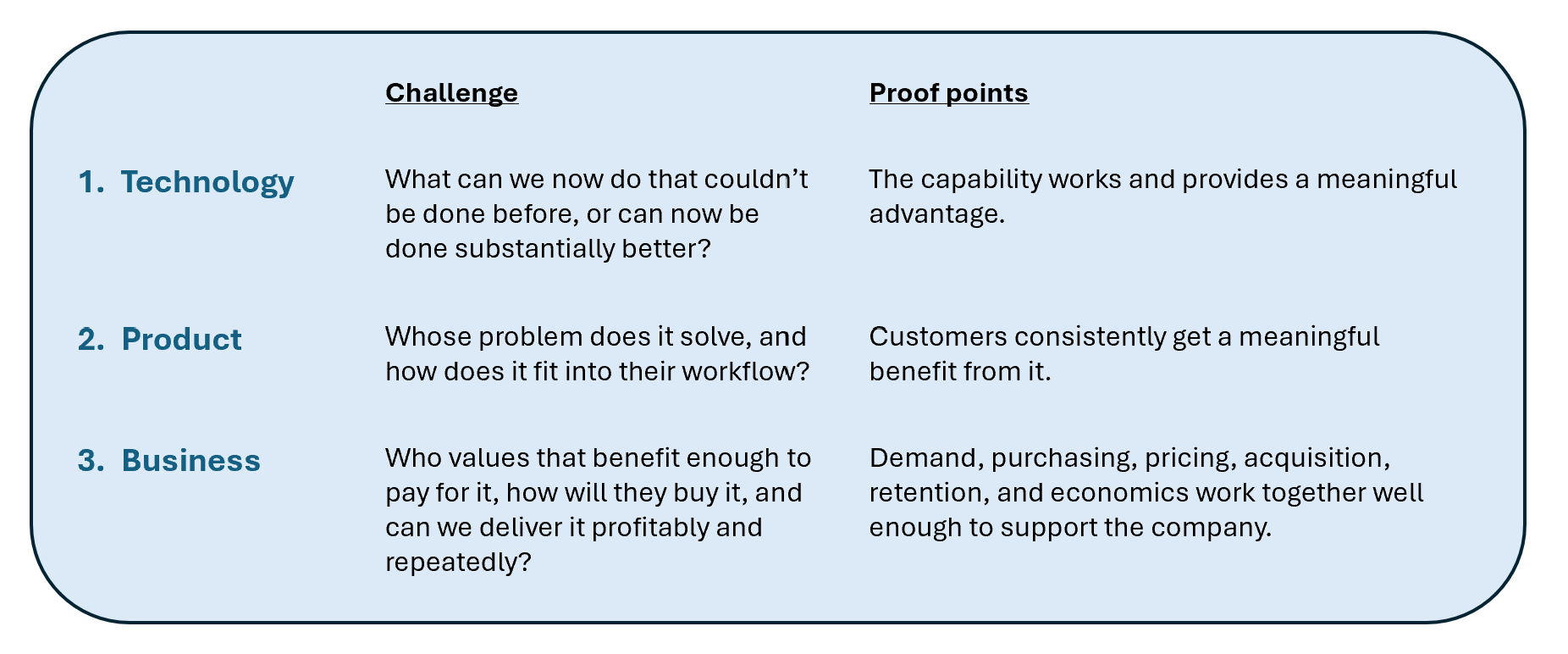
A lot of ventures spend enormous amounts of time proving the first two and assume they can figure out the third later.
Treat “Who Pays?” as a Requirement
Startup teams often get encouraging feedback that sounds like validation.
“That’s really interesting.”
“We could definitely use this.”
“If you added this feature, I could see my team using it.”
“We’d be happy to be a design partner.”
None of those people have necessarily told you they’ll pay for it.
The same applies to free trials and pilots. These efforts can tell you whether people are interested enough to spend some time with the product. They can help you understand workflows, refine roadmaps, and determine whether the technology actually delivers the solution you promised.
But they still don’t tell you whether someone will buy it.
Putting a price in front of a customer changes that conversation. Now they have to decide how much the problem is actually worth to them. For the budget-owner, your product has to compete against everything else that organization could do with the same money.
Getting someone to pay is stronger evidence than getting them to try it. Getting them to renew is stronger evidence again because now they’ve lived with the product and decided the value was worth paying for a second time.
That’s why “Who pays?” should be treated as a product requirement much earlier than it usually is.
As you’re building, keep asking three questions:
Are we solving an important enough problem, and does the product actually deliver the outcome we promised?
Can we identify, reach, persuade, transact with, onboard, and retain the customers we think should buy it?
At realistic pricing and cost levels, does this business ultimately generate more value than it consumes?
You don’t need perfect answers at the beginning to attract investment capital. You just need evidence that the answers are heading in the right direction.

The Closing Move
Technology is an enabling asset. Technology products package that capability into a value proposition. However, investors ultimately want a business model that shows you can turn that value into a company capable of generating returns on their investment.
Your endgame is a repeatable system where the customer gets enough value to purchase, and you retain enough of that revenue to keep building the company. Your product decisions, pricing, packaging, services, and sales motion eventually all have to support that same system.
And there may be more than one way to do that.
The same technology may work with different customers, different pricing, different packaging, different services, or entirely different sales motions. A business that doesn’t add up under one model may look very different under another. That’s worth figuring out before you become too invested in a single path.
You are ultimately trying to establish product-market fit, go-to-market fit, and economic fit. You don’t have to perfect all three at the same time. But you should be thinking about all three from the start and be able to articulate that to a prospective investor.
Every VC investment committee is trying to answer the same basic question: Is the opportunity compelling enough, and the potential return high enough, to justify putting their funds at risk? With the decisions you make from day one, you are creating evidence that your venture will satisfy their requirements.
As a founder, you may not realize it this early in the game, but your challenge is to put yourself in the investor’s shoes and think as seriously about how the money ultimately ends up in your (and their) pockets as you do about the product you’re creating.